

Visible light is much more complex than you might think.
 Stepping outdoors into sunlight; flipping on a wall switch indoors; turning on your computer, phone or other digital device — all of these things result in your eyes being exposed to a variety of visible (and sometimes invisible) light rays that can have a range of effects.
Most people are aware that sunlight contains visible light rays and also invisible ultraviolet rays that can tan or burn the skin. But what many don't know is that the visible light emitted by the sun comprises a range of different-colored light rays that contain different amounts of energy.
 What Is Blue Light?
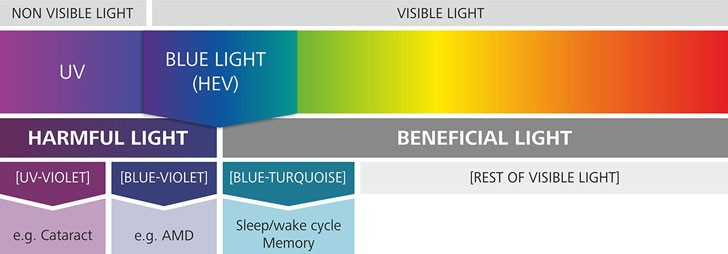
Sunlight contains red, orange, yellow, green and blue light rays and many shades of each of these colors, depending on the energy and wavelength of the individual rays (also called electromagnetic radiation). Combined, this spectrum of colored light rays creates what we call "white light" or sunlight.
Without getting into complicated physics, there is an inverse relationship between the wavelength of light rays and the amount of energy they contain. Light rays that have relatively long wavelengths contain less energy, and those with short wavelengths have more energy.
Rays on the red end of the visible light spectrum have longer wavelengths and, therefore, less energy. Rays on the blue end of the spectrum have shorter wavelengths and more energy.
 The electronic magnetic rays just beyond the red end of the visible light spectrum are called infrared — they are warming, but invisible. (The "warming lamps" you see keeping food warm at your local eatery emit infrared radiation. But these lamps also emit visible red light so people know they are on! The same is true for other types of heat lamps.)
On the other end of the visible light spectrum, blue light rays with the shortest wavelengths (and highest energy) are sometimes called blue-violet or violet light. This is why the invisible electronic magnetic rays just beyond the visible light spectrum are called ultraviolet (UV) radiation.


